
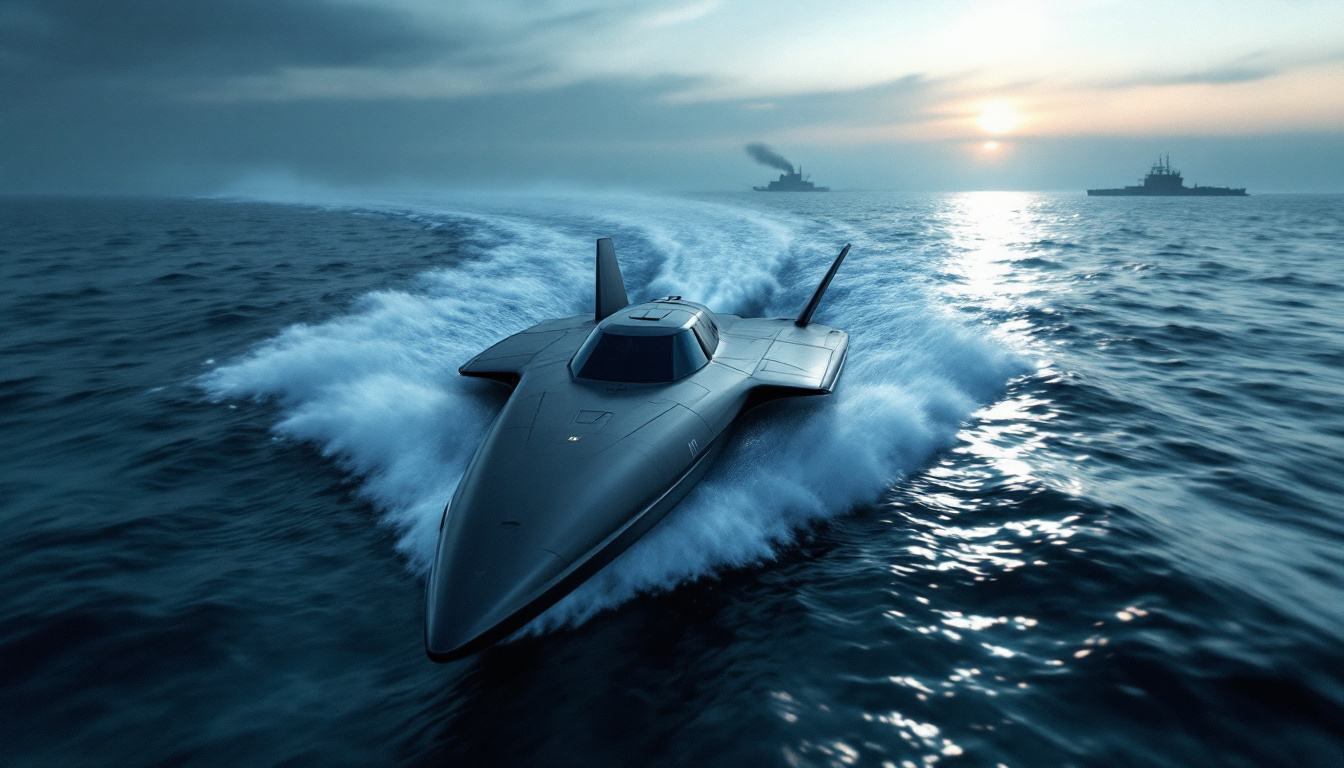
Three unmanned suicide drone-boats skimmed low across the Persian Gulf on Sunday, locked onto Iran's Bandar Abbas Naval Base, and blew a submarine maintenance facility into scrap metal. No pilot. No crew. No American lives at risk.
The robots went first.
U.S. Central Command confirmed the strike on July 13, stating that "using multiple one-way attack surface drones, CENTCOM forces successfully struck a submarine and ship maintenance facility in Iran." The weapon is the Saronic Corsair — an expendable, autonomous stealth drone-boat that skims the waterline, evades radar, and detonates on contact. Three of them hit the port simultaneously in a coordinated swarm.
What you're watching in that footage isn't something the Pentagon projected for another decade. Military planners had slotted autonomous strike drones and AI-enabled loitering munitions into the 2030s — future capabilities, future conflicts, future wars. Three weeks into a live shooting conflict with Iran, the future arrived early.
This is the first time American forces have deployed sea drones in combat. Let that land for a second. The weapon system that just hit Bandar Abbas is operational, combat-tested, and already being discussed for procurement in the tens of thousands.
The concept came from watching Ukraine. Starting in 2022, Ukrainian forces began sinking Russian Black Sea Fleet warships using maritime suicide drones — boats that cost a fraction of what they destroyed. The U.S. military watched, took notes, and built its own version. Faster. Stealthier. Designed to operate in swarms. The Corsair is the result.
The economics are what make this devastating for Iran. A single cruise missile runs north of a million dollars. A Corsair is a fraction of that cost, and you can send three — or thirty — at the same time. The Pentagon has discussed future procurement of "tens of thousands, and potentially hundreds of thousands" of these systems. That's not a weapons program. That's a production line for disposable naval warfare.
Iran's response has been conspicuously quiet. The Bandar Abbas facility services their submarine fleet — the same fleet Tehran has spent years expanding as the cornerstone of their Persian Gulf deterrence strategy. Losing a maintenance hub doesn't just damage ships. It disrupts the entire logistics chain that keeps those submarines operational. And there's no easy answer to a swarm of autonomous boats that costs less per unit than a pickup truck.
The usual voices will materialize with concerns about "autonomous weapons" and "escalation." Fair enough — autonomous warfare raises real questions. But three weeks into a shooting conflict where Iran has been testing every boundary it can find, the alternative to cheap autonomous drones is expensive manned missions with American sailors in the blast radius. That's the actual trade-off.
The footage CENTCOM released shows the Corsairs running low and fast, nearly invisible against the waterline, converging on the port from multiple angles before impact. It looks like something out of a science fiction sequence — except it's July 2026, it's real, and something is very much on fire at the end.
We landed on the moon with three astronauts. We hit Bandar Abbas with three robots.
The technology changes. The instinct doesn't.