
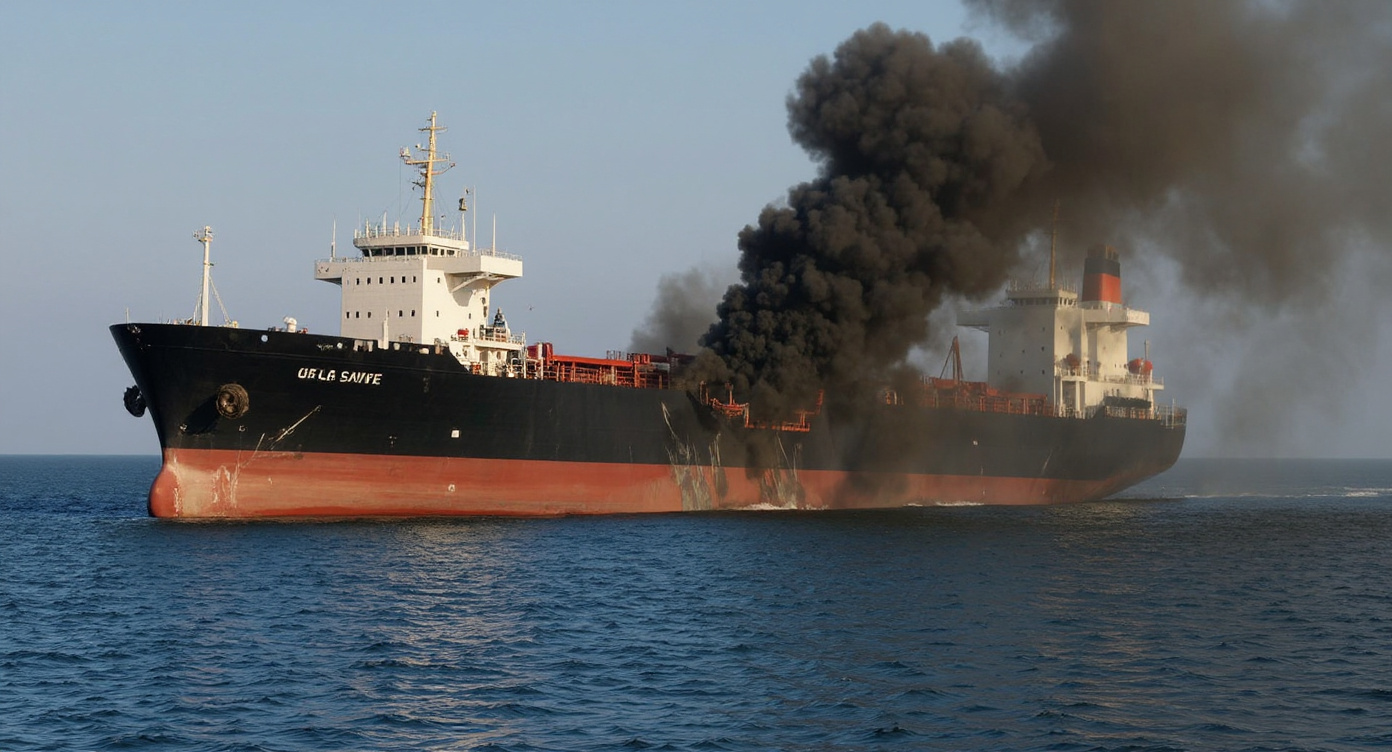
Five Iranian Revolutionary Guard Corps crude oil carriers are sitting at the bottom of the Gulf of Oman and near Kharg Island today. U.S. Central Command sank them on Tuesday in direct response to Iran's most recent failed attacks, bringing the week's total to eight tankers destroyed in less than five days.
That's not a negotiating tactic. That's a liquidation sale.
CENTCOM identified the vessels by name: the M/T Kaviz, M/T Charminar, M/T Horizon 1, and M/T Riesco went down in the Gulf of Oman, while the M/T Derya was destroyed near Kharg Island — Iran's primary oil export terminal. Three additional tankers had already been sunk on September 5. The crews were evacuated before the strikes, because apparently we're more concerned about Iranian sailors' safety than Iran is about launching attacks in the first place.
The tankers weren't commercial shipping. They were IRGC assets — floating ATMs that fund Tehran's proxy network across the Middle East. Every barrel that goes down with the hull is money that doesn't reach Hezbollah, the Houthis, or whatever militia Iran is bankrolling this week.
President Trump posted on Truth Social and made the administration's position explicit: "I'm not trying to force Iran to the bargaining table, as ABC Fake News reported. I couldn't care less if they sign a worthless, to them, agreement. I like our position now much better, with almost total control of the Hormuz Strait, and their economy totally collapsing."
No negotiations. No pallets of cash. No quiet back-channels through Oman. The strategy is to let Iran's revenue stream burn on the surface of the Gulf of Oman until there's nothing left to fund.
Secretary of the Treasury Scott Bessent reinforced the economic side of the squeeze. Under what the administration has branded "Operation Economic Outcast," the Treasury Department announced new sanctions targeting companies that continue to support Mahan Air, the Iranian airline that's been a known IRGC logistics arm for years. "Under Operation Economic Outcast, we promised severe consequences for those providing financial lifelines to the Iranian regime," Bessent said. "Today, we followed through on that promise with sanctions on companies that continue to support Mahan Air."
So the military sinks the tankers while Treasury chokes the financial network that moves the money. CENTCOM handles the hardware. Bessent handles the paper trail. Iran gets hit from both ends simultaneously.
The Strait of Hormuz — the 21-mile chokepoint through which roughly a fifth of the world's oil passes — is now functionally under American control. That's not a talking point. That's the operational reality Trump is describing. Iran can launch failed attacks from its coastline, but it can't move oil through waters the U.S. Navy dominates.
Eight tankers in five days. An economy the president himself describes as "totally collapsing." A sanctions regime with a name and a body count. The foreign policy establishment spent years arguing that the only path to containing Iran ran through a negotiating table in Vienna.
Turns out there was a shorter route through the Gulf of Oman.