
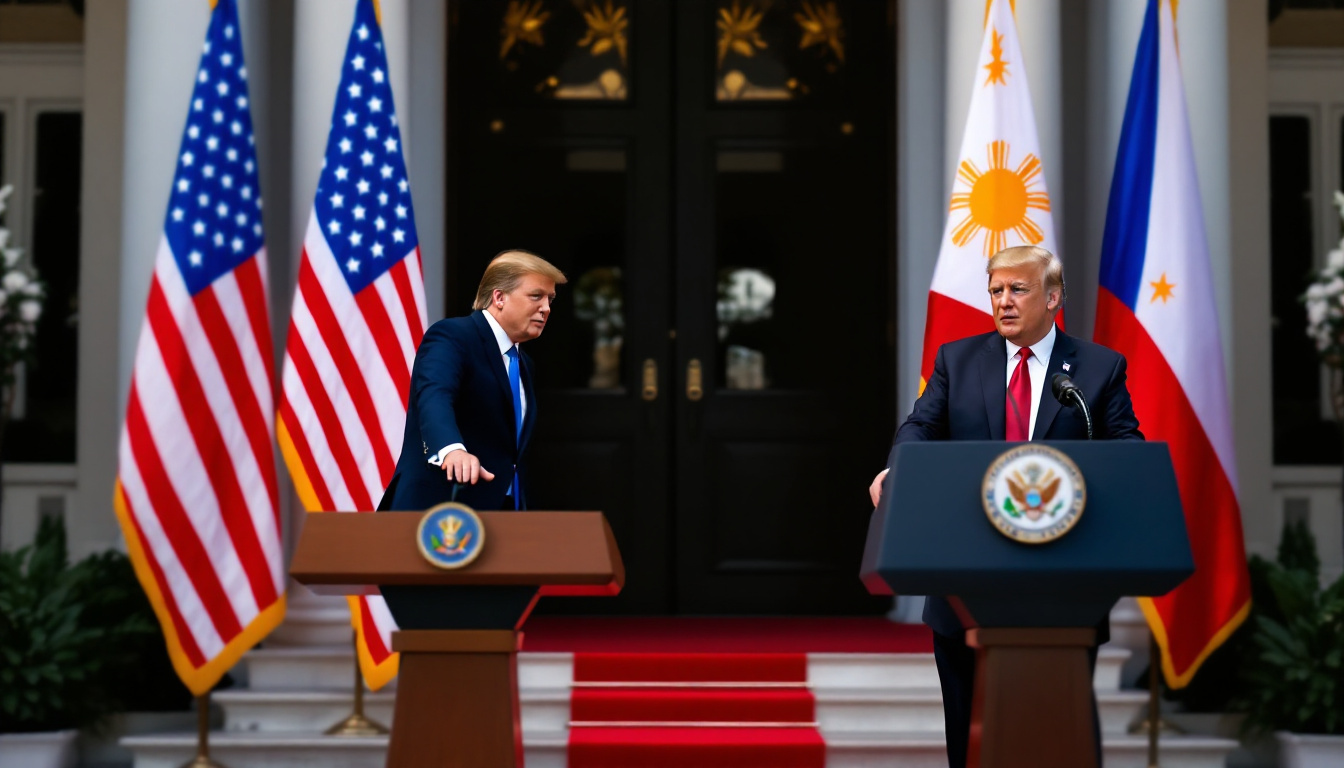
President Trump stood inside Malacañang Palace in Manila on Wednesday, announced the United States had just completed what he called the biggest trade deal in American history with the Philippines, and then told reporters he had no concerns whatsoever about China's aggression in the South China Sea. "That'll be taken care of," he said.
Twenty-four hours earlier, he'd signed a joint trade statement with Thailand. Next stop: China.
The Philippines deal came out of a bilateral meeting with Philippine President Ferdinand Marcos Jr. on the first leg of a three-day Asia tour that will end with historic trilateral nuclear talks involving Chinese President Xi Jinping and Russian President Vladimir Putin in Shenzhen. Trump didn't treat Manila like a layover. He treated it like a closing table.
"We've just consummated a very big trade deal, the biggest trade deal we've ever made, by far," Trump said at a state luncheon following the meeting. "And it's a fair deal for both countries." He added: "It's a magnificent deal for both."
The terms haven't been publicly released, and Philippine Ambassador to the United States Babes Romualdez confirmed nothing has been formally signed yet. What we do know: the deal covers the agriculture and energy sectors, the Philippines will open its market to U.S. goods with no tariffs, and the Philippines will pay a 19% tariff — down from the existing rate. Total goods and services trade between the two countries hit an estimated $40.9 billion in 2025, and the Philippines had been seeking relief from a 12.5% U.S. tariff on its goods. That context matters. This isn't a symbolic handshake. It's a restructuring of the fifth-largest trade relationship in the Pacific.
Trump also offered U.S. natural gas from a planned Alaska pipeline to supply the Philippines, described Manila as a "natural partner" for American energy exports, and announced the Philippines would be embracing American technology for its first modern nuclear project. On the defense side, he noted Washington has approved more than $5 billion in arms sales to the Philippines since he took office.
Marcos, for his part, said the two countries were "building stronger ties in trade, in investment, in energy, in technology, resilient supply chains, education." That's a Philippine president publicly aligning his economic future with Washington, not Beijing. Worth noting who wasn't mentioned at that luncheon.
The Thailand deal, signed a day earlier with Thai Prime Minister Anutin Charnvirakul, is just as concrete. Under the framework, Thailand will eliminate all tariffs on American exports and dismantle non-tariff barriers across vehicles, medical devices, pharmaceuticals, ethanol, and poultry. Thailand approved importing up to 1 million metric tons of zero-tariff U.S. corn — up from a previous annual quota of 54,700 tonnes at a 20% tariff. The Southeast Asian country committed to purchasing an estimated additional $2.6 billion in U.S. goods. Anutin said there's still "a little more to do" before the formal pact is signed, but the joint statement was inked.
The media frame on this trip, predictably, is that the details are vague and nothing is finalized. The same press corps that treated every Obama-era "framework agreement" and "memorandum of understanding" as historic diplomacy now needs a notarized contract before acknowledging Trump walked out of Manila with something real. Two bilateral trade frameworks in 48 hours, $5 billion in defense commitments, an energy export pipeline, and a nuclear technology agreement — but sure, the story is that Ambassador Romualdez said nothing was "signed."
"Today, under the leadership of President Marcos and myself, I'm proud to say that we're making the alliance between the United States and the Philippines much stronger than it's ever been before," Trump said, "especially with the consummation of this deal."
He flies to Shenzhen next. Xi Jinping and Vladimir Putin are waiting. Thailand is done. The Philippines is done. The $40.9 billion relationship just got restructured, $2.6 billion in new Thai purchases are locked in, and China knows every country in the region just watched two of its neighbors cut deals with Washington.
That's the scorecard heading into the room.