
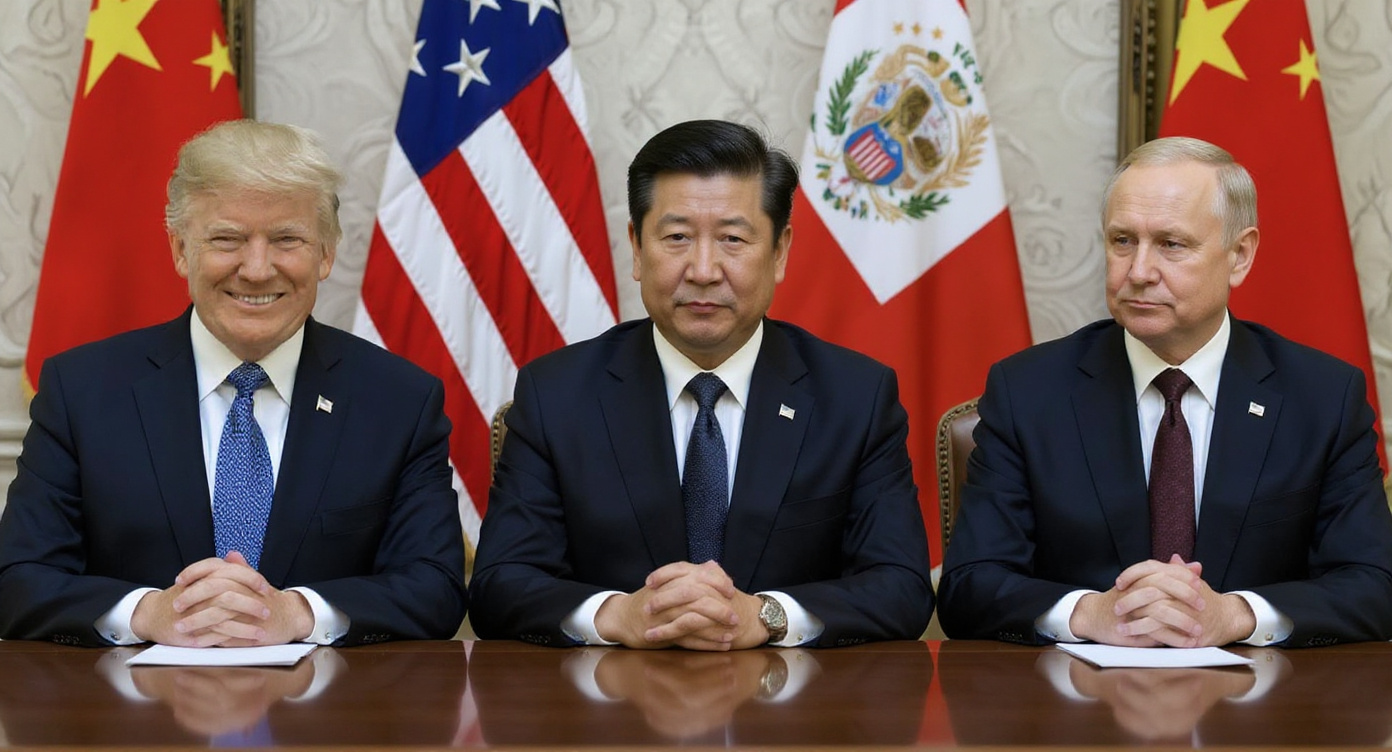
President Trump touched down at Ninoy Aquino International Airport in Manila on Tuesday morning, greeted by Philippine President Ferdinand Marcos Jr. with full military honors — the first stop on a three-day Asia trip that ends with something no American president has ever attempted: a trilateral nuclear summit with Chinese President Xi Jinping and Russian President Vladimir Putin.
The foreign policy establishment spent years insisting this couldn't happen. Trump booked the room anyway.
The schedule alone would make a normal diplomat sweat. Tuesday night, Trump attends the gala dinner at the 49th ASEAN summit, the annual gathering of Southeast Asian leaders in Manila. Wednesday, he flies to Shenzhen, China, for the Asia-Pacific Economic Cooperation summit, where the three-way nuclear talks take place on the sidelines. The meeting marks the first time the leaders of the United States, China, and Russia have sat at the same table — not for a photo op, not for a handshake rotation, but for substantive nuclear proliferation negotiations with Russia's war in Ukraine grinding through its fifth year.
And Trump, fresh off midterm losses that had every Beltway columnist writing his political obituary, isn't acting like a man on the ropes. He's acting like a man with a schedule to keep.
Philippine Ambassador Jose Manuel Romualdez told the Associated Press that Trump's first question upon seeing Marcos wasn't about trade or the South China Sea — it was "How's Imelda?" referring to the former First Lady, now 97 years old and using a wheelchair. "Personal connections are very important to him," Romualdez said. Romualdez added that "President Trump was very happy and told Marcos, 'please say hello to your mother.'"
That's the detail the foreign policy class never processes. The same guy who asks about an elderly woman's health is about to broker a nuclear conversation between two leaders the State Department has spent decades keeping in separate rooms. The personal touch isn't the sideshow. It's the method.
The trip isn't just summitry. Thailand has pledged over $18 billion in spending on U.S. aircraft as part of a broader trade framework announced in October, with Thai tariffs dropping on American autos, food, and pharmaceuticals. Additional commercial announcements are expected across aviation, defense, energy, and technology sectors. Trump also chairs the first Quad nations meeting — the U.S., Australia, India, and Japan — since he returned to office.
About 1,500 left-wing protesters rallied at Liwasang Bonifacio square in downtown Manila. Protest leader Teddy Casiño called on the Marcos administration to "stop being a puppet of Donald Trump and to uphold an independent foreign policy for the Philippines." The Philippine government did not appear to take his advice.
The nuclear talks Wednesday represent something specific: an American president who looked at the conventional diplomatic wisdom — that you manage Beijing and Moscow separately, that you never give either one a stage with the other, that the risk of a trilateral meeting outweighs any reward — and decided the conventional wisdom produced five years of war in Ukraine and an accelerating arms race with China.
So he's trying the other thing.
The experts who said this meeting would never happen are the same experts who said NATO expansion wouldn't provoke Russia, that the Iran deal would moderate Tehran, and that strategic patience with North Korea was working. Their track record is the best argument for letting someone else drive.
Whether the Shenzhen talks produce a framework, a freeze, or just a foundation for future negotiations, the fact that they're happening at all answers a question the establishment has been dodging for decades: what happens when you stop managing the problem and try to solve it?
Wednesday in Shenzhen, we find out.