
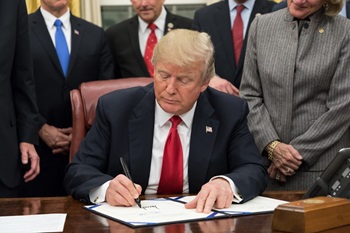
On June 30, the Supreme Court struck down President Trump's executive order targeting birthright citizenship. Five weeks later, the president walked into the Oval Office, picked up a pen, and signed two more.
He wasn't kidding when he said he'd go around them.
President Trump signed a pair of new executive orders on August 6 targeting birthright citizenship and birth tourism, openly acknowledging the Supreme Court's ruling while making clear he considers it a speed bump, not a stop sign. "We had a very unfortunate decision in the Supreme Court concerning birthright," Trump said at the signing. "It was close, but a very, very unfortunate decision. So we're making adjustments because it's very unfair."
The original order, signed on his first day back in office, cast the widest possible net — denying citizenship to children of tourists, students, H-1B workers, and undocumented immigrants alike. Essentially anyone without a green card. The Supreme Court struck it down 6-3. These two orders don't make the same mistake.
Deputy Chief of Staff for Policy Stephen Miller, who also serves as Homeland Security adviser, laid out the constitutional argument behind the first of the new orders. Miller pointed to the original purpose of the 14th Amendment, passed after the Civil War to guarantee citizenship to freed slaves and their descendants. "It had no other meaning and purpose other than that," Miller said, arguing the amendment was never intended to grant automatic citizenship to children born to foreign nationals on American soil.
Miller went further, identifying specific categories of people who the administration argues fall outside the amendment's protections. "That includes, for instance, alien enemies of the United States, members of foreign terrorist organizations, and large categories of people who lobby and act on behalf of foreign governments," he said.
The 14th Amendment grants citizenship to anyone born in the United States "subject to the jurisdiction thereof." That phrase is the whole game. The administration's argument is that alien enemies, terrorist organization members, and registered foreign agents aren't meaningfully subject to American jurisdiction — they're working against it. It's a narrower claim than the original order made. The Supreme Court already told them what "too broad" looks like.
The second order operates on different legal ground altogether. It takes direct aim at birth tourism — the practice of foreign nationals traveling to the United States specifically to give birth on American soil, securing citizenship for the child. Miller didn't mince words: "The idea that people come here, pretend to be a tourist, pretend to be a visitor, say they want to go to Disney Land … but the real reason they are here is to have a child, make that child an automatic citizen, leave our country, and then have a U.S. citizen child — it gives them access, under this broken system, to welfare benefits, ultimately the voting booth … that practice of birth tourism, is as of the signing of this order, hereby banned."
That means the Secretary of State can deny visas to foreign nationals whose real purpose for entry is a delivery room rather than Disney World — and DHS can remove those who misrepresented their intentions to get in anyway. No 14th Amendment debate required. Just immigration fraud enforcement.
Trump added his own assessment of the industry that's grown around the practice. "That's not the way it was supposed to work. It's a disgrace. They are buying their way in. We are not going to let it happen."
The legal challenges will come. They came last time, and they'll come again. Every immigration advocacy group in America probably had their press releases half-written before the ink dried. And we'll hear the usual chorus about constitutional overreach from the same people who spent four years insisting executive orders were the backbone of democracy when their guy was signing them.
But the structure here is deliberately different from round one. Rather than a single broad order the Court could swat down in one ruling, the administration split into two targeted actions built on two separate legal theories. The first engages the "subject to the jurisdiction" clause in its most defensible form — people formally designated as enemies, terrorists, and foreign agents. The second bypasses the constitutional question entirely, treating birth tourism as the visa fraud it is. Harder to challenge as a package. Designed to force courts to engage one argument at a time.
The Supreme Court ruled 6-3 against the first attempt. The administration is betting that narrower, more precisely targeted orders survive judicial review — or at minimum, force the courts to engage with the underlying legal question rather than dismissing it on procedural grounds.
The Court said no. The president said "we're making adjustments." In Washington, that's as close as you get to a dare.