
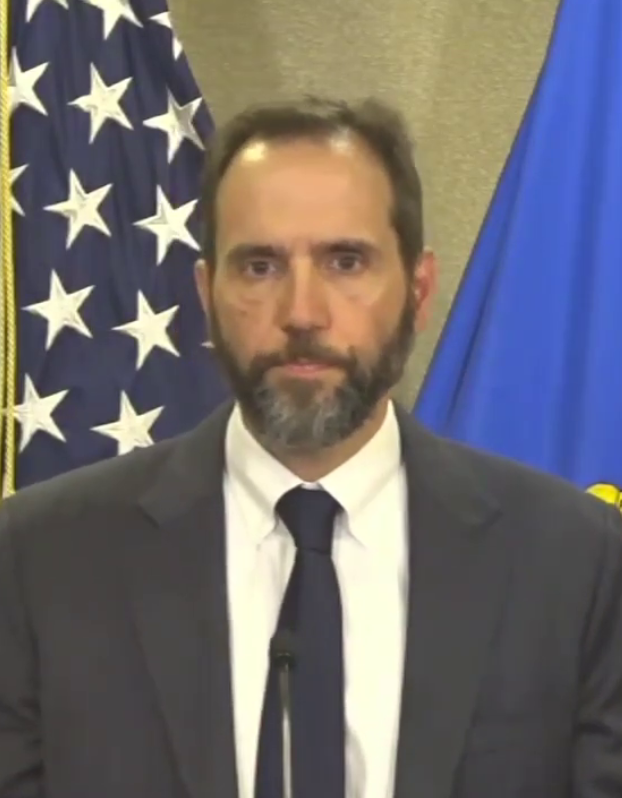
In December 2025, former Special Counsel Jack Smith sat before congressional investigators and was asked a simple question: did his team access the contents of lawmakers' private text messages during his sprawling election probe? Smith's answer was one word. "No."
That answer, according to multiple U.S. senators, appears to have been a lie.
Sen. Eric Schmitt, a Republican from Missouri and member of the Senate Judiciary Committee, is now calling for a full federal investigation into whether Smith committed perjury. Under 18 USC § 1001, knowingly making false statements to Congress is a federal crime punishable by up to five years in prison. Schmitt put it plainly: "Knowingly making false statements to Congress is a federal crime."
Sen. Josh Hawley, also a Missouri Republican, was less diplomatic. His assessment of Smith's congressional testimony came in two words: "Looks like perjury."
The allegation centers on what investigators have dubbed "Arctic Frost" — Smith's operation that issued over 200 subpoenas and swept up records on more than 160 Republicans, including 8 Republican senators and at least 1 GOP House member. The targets weren't limited to elected officials. Smith's net caught more than 400 Republican personalities and groups, including Trump for President Inc., Turning Point USA, the Republican Attorneys General Association, America First Policy Institute, Save America PAC, and the Conservative Partnership Institute.
The Constitution's Speech or Debate Clause — Article I, Section 6 — exists specifically to protect lawmakers' communications from executive branch fishing expeditions. Smith's team was supposed to route potentially privileged material through a Filter Team designed to evaluate what prosecutors could and couldn't see. The new revelations suggest that process was bypassed, and that Smith's team accessed the content of 44 lawmakers' text messages directly.
Then Smith sat before Congress and said they didn't.
The timing of these accusations isn't accidental. They surfaced alongside the July 15 confirmation hearing for Acting Attorney General Todd Blanche before the Senate Judiciary Committee. When pressed on the matter, Blanche acknowledged the gravity: "We take testimony in front of this body very seriously, yes." Senate Judiciary Committee Chairman Chuck Grassley, Republican of Iowa, went further, calling "Arctic Frost and related weaponization" something that "was arguably worse than Watergate."
Grassley's comparison carries weight. Watergate involved a president's team breaking into the opposition party's offices. Arctic Frost, if the allegations hold, involved a special counsel vacuuming up the private communications of sitting members of Congress — the people who are supposed to be conducting oversight of the executive branch — and then allegedly lying about it under oath.
Smith's defenders will argue that the probe was necessary to investigate the events of January 6, 2021, and that accessing these records fell within the scope of his authority. But scope and honesty are two different questions. Even if every subpoena was legally justified, the question before Congress now is whether Smith told the truth about what his team did with the material.The evidence increasingly suggests he didn't.
Smith spent years building a case that Donald Trump was a threat to democracy because he allegedly lied. He prosecuted. He investigated. He issued subpoenas by the hundreds. He targeted a former president, sitting senators, and hundreds of Republican operatives and organizations.
Now the record shows 200 subpoenas, 44 lawmakers' messages accessed, a constitutional protection apparently circumvented, and a one-word answer to Congress that doesn't appear to be true. The man who built his career on holding others accountable for their statements may have made a false one of his own — under oath, to the body he was supposedly serving.