
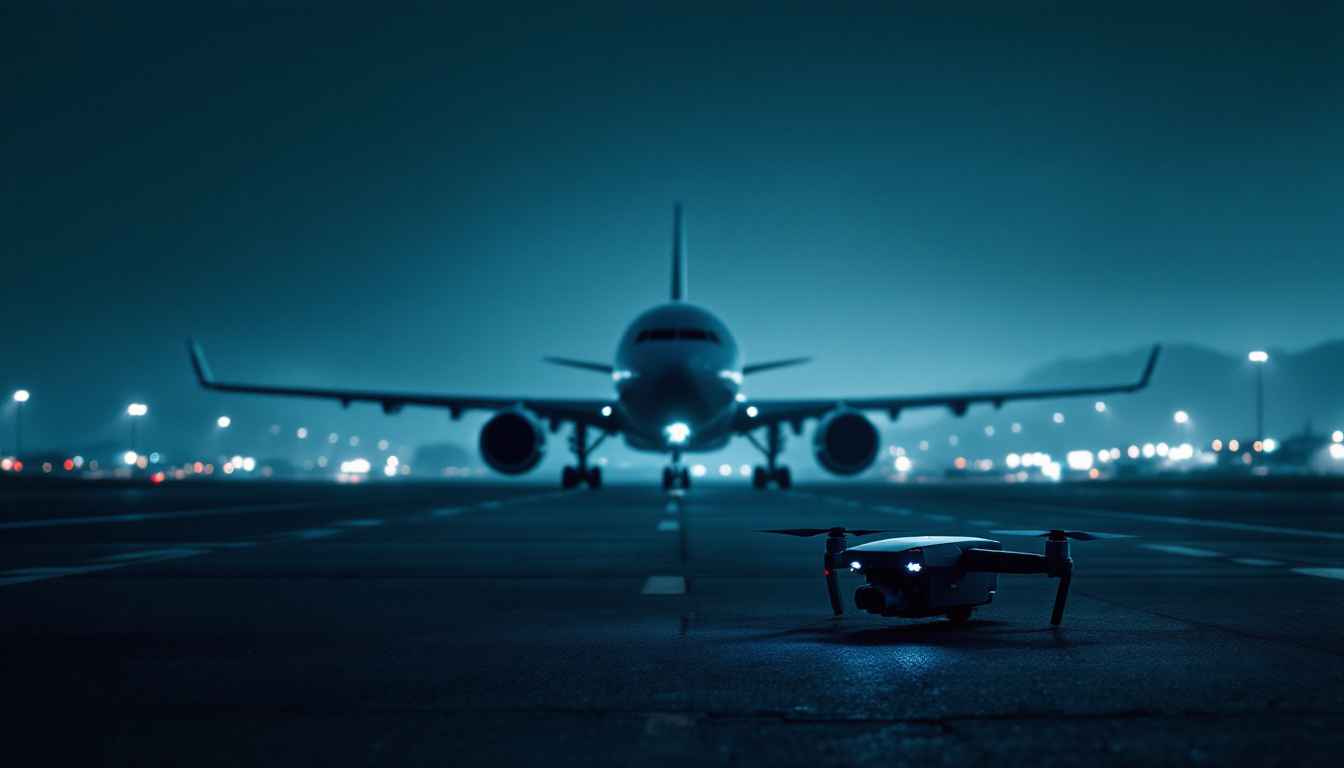
On the night of August 5, a drone packed with high explosives landed on the south runway of Leipzig/Halle Airport in eastern Germany, right next to a Ukrainian Antonov AN-124-100 cargo plane. The detonator tore off on impact. That malfunction is the only reason the plane didn't become a fireball.
A second drone hit a DHL cargo plane that had aborted its landing because the runway was already shut down. That aircraft limped to Hannover, approximately 125 miles northwest, with minor damage.
German Interior Minister Alexander Dobrindt held a press conference the next morning and used the kind of language that should make every frequent flyer's ears perk up. "First of all, I must say that we have to assume we are dealing with a very serious, security-related incident here," Dobrindt said. "My assessment is that we are dealing with a hybrid attack scenario here."
A hybrid attack scenario. That's diplomat-speak for "a foreign government just tried to blow up an airplane on our soil, but we'd rather not say the name out loud."
Western intelligence officials initial assessment indicates the drone "most likely belonged to Russia."
The broader implications of this attack point to a new kind of terrorist attack. Leipzig/Halle Airport is a major NATO logistics hub. It handles 2,500 tonnes of freight daily across 23,600 annual cargo flight movements. It's home to a massive DHL sorting facility that the company calls "the heart of a global logistics chain." And since Russia's 2022 invasion of Ukraine destroyed Antonov Airlines' home base, the airport has housed Ukrainian military transport aircraft under a NATO contract called the Strategic Airlift International Solution, or SALIS, involving nine allied nations.
So this wasn't a random airport. This was a strategic military target dressed up as a civilian freight hub. And somebody walked a bomb right up to the front door.
Saxony's Interior Minister Armin Schuster described the emerging reality as an "arms race" between attackers and security authorities. Drone expert Christian Kaiser explained that intercepting drones is "only the final step" after detection via frequency scanners, cameras, or radar. Which raises an uncomfortable question: if Germany — one of the most technologically advanced nations on earth — can't stop a single explosive drone from landing on a runway at a major airport, who can?
This isn't even the first time Leipzig/Halle has been targeted. In July 2024, four parcels rigged with incendiary devices were sent through DHL and DPD shipping. One of them ignited at the Leipzig sorting center before it could be loaded onto a plane. Germany recorded 151 drone incidents at airports nationwide in 2023, with 21 of those at Leipzig/Halle alone. The federal police weren't even authorized to shoot down drones until October 2025.
European Commission President Ursula von der Leyen stated during a visit to Vilnius that Russia deliberately uses drones "to test the security of the European Union's airspace" as part of a strategy to "destabilise democratic societies." That's the head of the European Commission confirming, out loud, that a nuclear-armed nation is running test attacks against European airports.
The investigation now involves the Dresden Public Prosecutor, the Saxony State Criminal Police, the Central Office for Extremism Saxony, and a state terrorism unit. That's a lot of agencies for an incident the Interior Minister says we shouldn't speculate about.
Every security expert quoted in the coverage keeps circling back to the same point: the technology to do this is cheap, widely available, and nearly impossible to defend against at scale. A consumer drone costs a few hundred dollars. Semtex is not hard to acquire if you know the right people. And airports, by definition, have giant flat surfaces where things are supposed to land.