
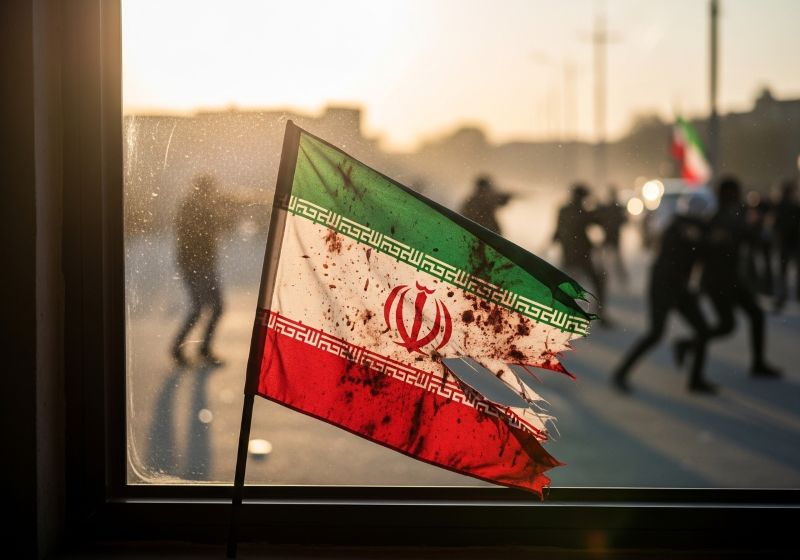
The Iranian rial hit 2.02 million to the dollar on informal markets this week. The official Central Bank rate sits at 1.5 million. The gap between those two numbers tells you everything about a regime that has lost control of its own economy and knows it.
Mohammad Bagher Ghalibaf, speaking Thursday at the Iranian Embassy in Baghdad to a room of Iranian and Iraqi business figures, delivered what might be the most remarkable concession a senior Iranian official has made in decades. His exact words: "No matter how much military power we have, if people are hungry and we do not have financial circulation and economic growth, we will not endure."
Read that quote again — not because it's surprising, but because of who said it. This isn't a dissident on a smuggled podcast. This is the Speaker of the Iranian Parliament, a regime loyalist, standing in a foreign capital and admitting the Islamic Republic might not survive its current trajectory if the country's hardliners don't give in and take Trump's deal.
The context makes it worse for Tehran. U.S. Treasury Secretary Scott Bessent has enacted "the toughest sanctions in history" against Iran, including secondary sanctions targeting any country still doing business with the regime. Bessent wrote in a Financial Times op-ed that "President Trump decimated Iran's economy to a point where the rial has never been weaker and inflation has rarely been higher." That's not campaign rhetoric. That's a Treasury Secretary citing his own receipts.
The United Arab Emirates announced last week that it was suspending all trade with Iran — a move that came after President Trump personally called Sheikh Mohammed bin Zayed Al Nahyan. Vice President JD Vance added that Tehran cannot withstand pressure "for a couple of weeks or a couple of months or possibly longer." The war that began on February 28 is now nearly six months old, and the economic noose has tightened every week.
Ghalibaf tried to frame his Baghdad trip as a show of strength, pushing for trade in local currencies — Iranian rials and Iraqi dinars — instead of dollars. He called U.S. sanctions "tyrannical" and said bilateral currency settlement would strike "a blow against the American currency." The problem with that argument is that nobody wants to hold rials right now, including Iranians.
The regime's response has been predictably theatrical. Foreign Minister Abbas Araghchi dismissed the coming sanctions as "the so-called 'Economic D-Day'" and called it "a diversion from America's own crisis: unprecedented debt and surging interest costs." Mohsen Rezaei, the hardline leader of Iran's Supreme National Security Council, warned that any country supporting new American economic measures would be committing "an act of war." When your threats start sounding like a cornered animal's hiss, you've already lost the negotiating leverage you're pretending to have.
Inside Iran, Ghalibaf's comments sparked a backlash from hardliners who accused him of projecting weakness. Former state television presenter Masoud Barati called it a "message of weakness." Friday prayer leaders in cities from Kermanshah to Ardabil to Semnan dutifully echoed the regime's strength narrative. But none of them disputed the numbers. Because the numbers aren't disputable. One-fifth of the world's traded oil transits the Strait of Hormuz, and Iran still can't sell enough of its own crude to keep its currency from collapsing.
The sanctions campaign that started under Trump's first term, got dismantled under Biden, and came roaring back in 2025 has now produced something no diplomatic summit ever could: a senior Iranian official publicly admitting his government might not survive.
Bessent's "Economic D-Day" hasn't been live for even 24 hours yet. The rial is already at a record low. The UAE has already cut off trade--and other country's are expected to follow suit immediately. And Iran's own top leader is begging the regime's hardliners in the IRGC to accept defeat and come to terms with Trump's negotiators.
When the regime's spokesman sounds like the regime's eulogy, the pressure is working exactly as designed.