
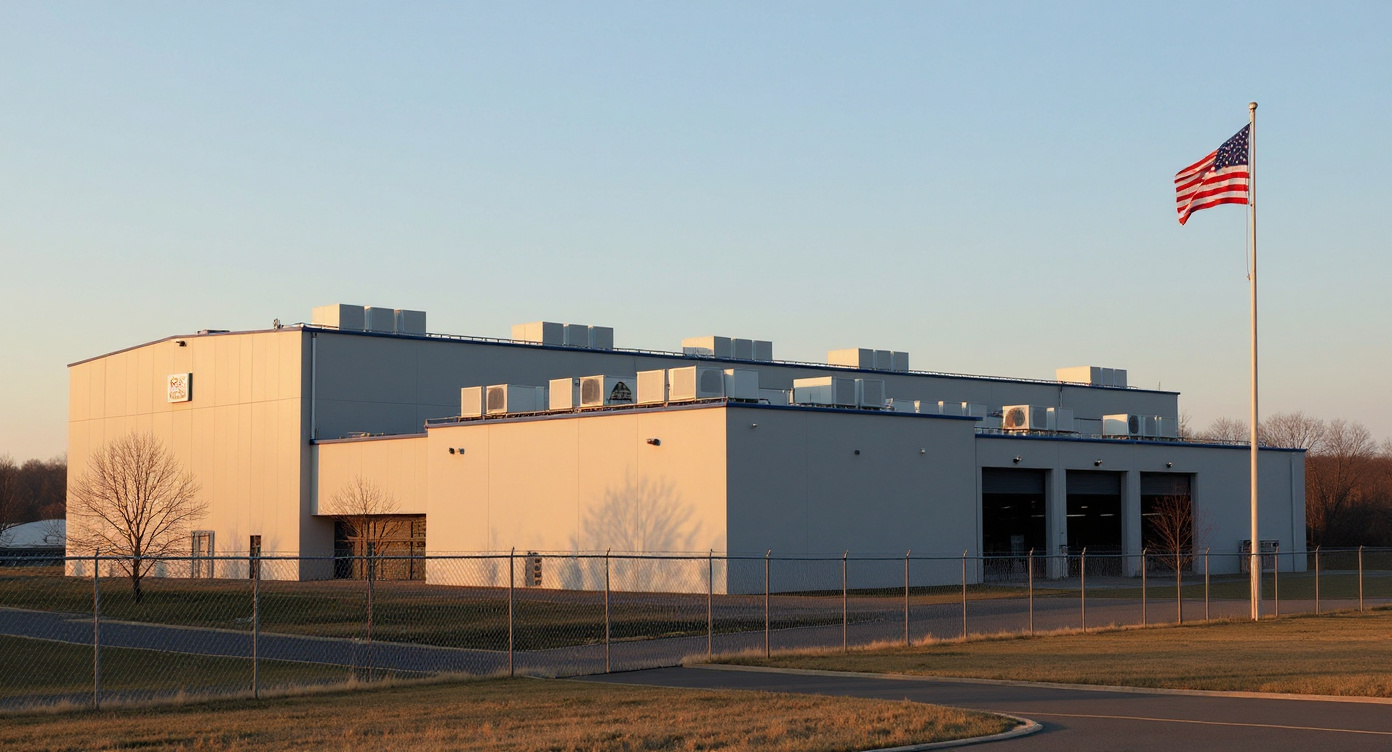
In Loudon County, Virginia, data centers occupy 3% of the land and generate 45% of the local tax revenue. That ratio — tiny footprint, enormous tax base — dropped the county's property tax rate from $1.145 per $100 in 2016 to $0.805 in 2026. Homeowners in Loudon County are paying less because server farms showed up and started writing checks.
Sen. Ron Wyden, Democrat from Oregon, wants to tax them for it.
Wyden's new legislation, S. 080626, would impose a gross revenue tax on data centers at what Cato Institute analyst Adam Michel describes as "a low single-digit rate." The bill landed the same week Democrats across the party started echoing a coordinated line: data centers are draining the grid, gulping the water supply, and ruining neighborhoods. Former president Barack Obama jumped in too, telling Politico he'd advise Democrats to have "a very clear plan" on AI — which in practice means positioning data centers as the villain in a midterm energy narrative.
The timing is not subtle. A Gallup poll found 70% of Americans oppose data centers being built near them, with 48% strongly opposed. That's a focus-group goldmine for a party looking for something — anything — to run on in the midterms besides their own record. The playbook writes itself: find something voters don't like the sound of, attach it to Big Tech, propose a tax.
Except the actual numbers don't cooperate.
Data centers consume less than 0.05% of the nation's freshwater supply, according to the Electric Power Research Institute. Not 5%. Not half a percent. Five hundredths of one percent. The "they're draining our water" panic requires ignoring two decimal places.
On the power grid, the Goldwater Institute found that the massive infrastructure investment driven by data center construction has actually reduced retail electricity rates by 4%. The buildings Democrats want to punish for straining the grid are the same buildings subsidizing the grid's expansion. Every new data center that comes online brings transmission upgrades, substation capacity, and generation investment that wouldn't exist without the private capital behind it.
The environmental objections arrived on cue, carried by a 27-year-old former Anthropic employee named Jacob Coxon who announced his resignation on social media: "I resigned from Anthropic today... Neither company is acting responsibly." Coxon's complaint was about AI safety, not data center power consumption, but the resignation got folded into the broader "tech is reckless" narrative Democrats are building. One guy quits his job and suddenly he's Exhibit A in the case against server cooling systems.
Wyden's bill taxes gross revenue — not profit, not net income, gross revenue. That distinction matters because it means the tax hits regardless of whether a data center is profitable. A facility operating at a loss still pays. Adam Michel's analysis at Cato points out this is the kind of tax structure that discourages exactly the infrastructure investment that made Loudon County's property tax miracle possible. You don't get the next Loudon County if the federal government skims off the top before the local benefits materialize.
The residents of Loudon County aren't complaining. Their property taxes went down by roughly 30% over a decade while their county services stayed funded. The data centers didn't displace neighborhoods. They filled industrial corridors and empty lots. They brought construction jobs, permanent technical positions, and a tax base that doesn't send kids to public school or call the police at 2 a.m.
That's the part Democrats don't mention when they wave the Gallup poll around. Seventy percent of Americans oppose data centers near them the same way seventy percent of Americans oppose a lot of things they've never actually lived next to. People who live near functioning data centers got quieter utility bills and lower taxes. People who don't live near them got a survey question.
Obama's advice to his party — have a clear plan on AI — sounds reasonable until you notice what the "clear plan" always turns out to be. Tax something productive. Regulate something competitive. Run against an industry that employs Americans and funds local government, because the alternative is running on your own platform.
Loudon County's property tax rate dropped 30% in a decade. Wyden's bill would make sure that doesn't happen anywhere else.
The plan is clear enough.