
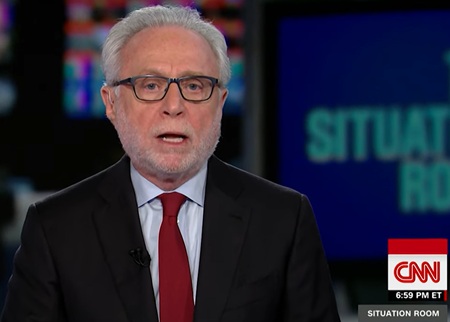
On August 31st, CNN anchor Wolf Blitzer sat behind his desk on "The Situation Room" and delivered what the network called "a quick note of clarification." That's CNN's way of saying they got caught pushing a story that wasn't true and had to publicly admit it before someone else made it worse.
The lie in question: that President Trump's executive order on mail-in ballots would prevent U.S. troops stationed overseas from voting.
The March 31st White House order was straightforward. It directed federal agencies to provide citizenship verification lists to states within 60 days before elections and tightened security protocols around mail-in voting. The order was designed to verify citizenship in federal elections. Standard election integrity stuff. But CNN — and Democratic Virginia Governor Abigail Spanberger — ran with a narrative that the order would strip military service members of their ability to vote by mail.
Spanberger agreed on-air with the suggestion that troops overseas "totally rely" on mail-in ballots, which is true. What isn't true is that Trump's order affects them. Military and overseas voters are protected under UOCAVA — the Uniformed and Overseas Citizens Absentee Voting Act — which explicitly exempts them from the kinds of verification requirements the executive order imposed. Federal law already requires election officials to send military ballots at least 45 days before the November 3rd election. The executive order didn't change that. Didn't touch it. Didn't come within a zip code of it.
CNN knew this before the segment ever aired. UOCAVA isn't obscure legislation buried in a footnote somewhere. It's one of the most well-known voting protections in federal law, specifically because it exists to make sure deployed service members can vote. Any producer who spent four minutes researching the claim would have found it. They either didn't check or didn't care.
Blitzer's correction on August 31st acknowledged that military and overseas ballots are exempt under UOCAVA. But here's the thing about CNN corrections — they always arrive quieter than the original claim. The false story gets the panel discussion, the chyron, the governor nodding along in agreement. The correction gets a "quick note" tucked between segments.
This is the model. Float a claim designed to make Trump look like he's hurting the troops. Let it circulate for days. Then issue a correction so understated it functions more as a legal shield than an actual retraction. The damage is already done — the clip already shared, the narrative already absorbed by viewers who will never see the walkback.
The timing wasn't accidental either. With the November 3rd election approaching, a story about troops losing their vote carries maximum emotional weight. Military families hear "your spouse can't vote" and they don't wait for the correction. They react. That's the point. The retraction is built into the strategy — not as accountability, but as insurance.