
Let’s get something straight before we start. The strikes on Iran were necessary. The regime was building nuclear weapons, funding terrorism on four continents, and actively planning attacks on American military bases. Trump and Netanyahu did what needed to be done, and the world is safer for it.
But safer doesn’t mean painless. And anyone telling you there’s no economic price tag attached to dismantling a terror state that sits on top of some of the most important energy infrastructure on the planet is selling you something.
The bill is arriving. The only question is how big it gets.
The Coyote Hasn’t Looked Down Yet
There’s a reason the Wile E. Coyote metaphor keeps showing up in financial circles. The coyote runs off the cliff, keeps pumping his legs in mid-air, and everything seems fine — until he looks down. Then gravity remembers he exists.
Yves Smith — a former Goldman Sachs analyst who called the 2007-2009 financial crisis before most of Wall Street could spell “subprime” — is warning that global markets haven’t priced in what’s actually happening. The kinetic war is dominating the headlines, but the financial shockwave is still building underneath like an earthquake nobody’s felt yet.
Smith compared the current market psychology to the denialism that preceded the 2008 crash — everyone watching the cracks form and convincing themselves the foundation is solid. It wasn’t then. It might not be now.
The Numbers That Matter
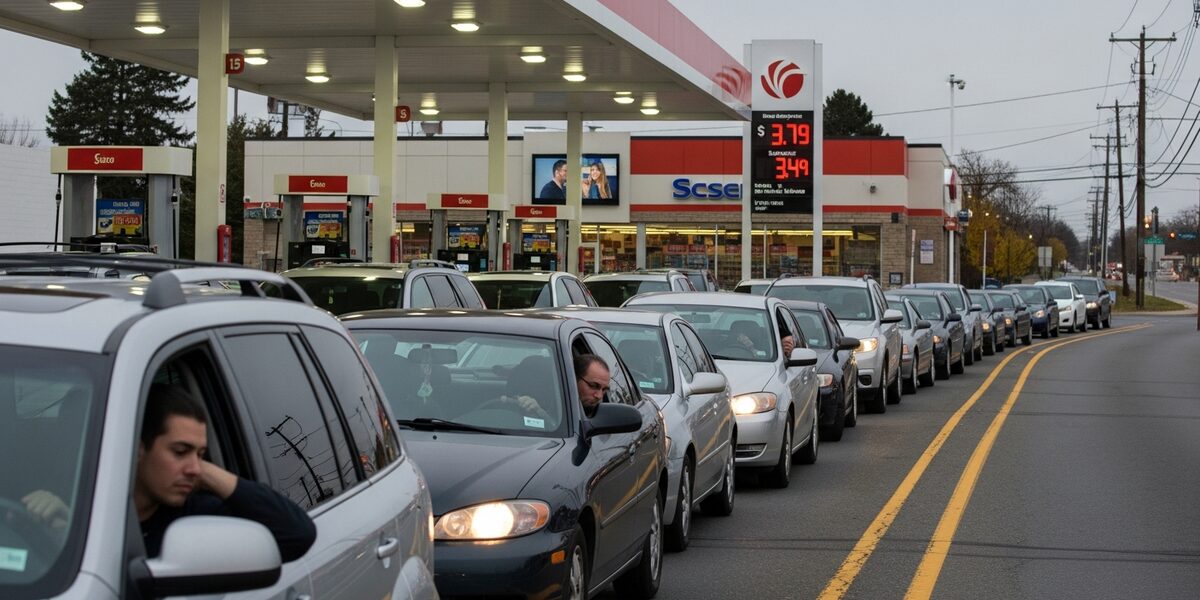
Here’s what’s already moving. Gas prices surged past $3 a gallon overnight. Oil prices are climbing. The stock market is taking hits. And those are just the first tremors.
The real threat sits in a narrow strip of water called the Strait of Hormuz — the bottleneck through which roughly 20 percent of the world’s oil and liquid natural gas supply travels. The strait hasn’t been officially closed, but it might as well be. Major shipping companies have suspended traffic because war risk insurance has become either unavailable or unaffordable. Tanker traffic has plummeted.
When one-fifth of the global energy supply can’t get to market, the math gets ugly fast. Every day the strait stays functionally closed is another day of constrained supply meeting unchanged demand. That equation only moves prices in one direction.
China Blinks
You know the situation is serious when Beijing starts making public statements. China’s Foreign Ministry is openly urging all parties to “immediately cease military operations” and “safeguard the safety of navigation in the Strait of Hormuz.”
China doesn’t make those statements out of humanitarian concern. They make them because their economy runs on Middle Eastern energy imports, and a prolonged disruption threatens to trigger a downturn in the world’s second-largest economy. When China is publicly begging for de-escalation, it means their economists are running models that scare them.
And if China’s economy contracts, that ripple hits global supply chains, manufacturing, and trade flows in ways that touch every American consumer — from the price of electronics to the cost of building materials.
The Republican Vulnerability
Here’s the part nobody in the GOP wants to hear, but Bob’s going to say it anyway: rising gas prices killed Joe Biden. They will kill Republicans just as dead if they’re not careful.
Voters have short memories and empty wallets. They supported the Iran strikes overwhelmingly — and they should, because the strikes were right. But “right” and “affordable” are two different conversations, and the second one happens at the gas pump every single week.
If gas hits $4 a gallon by summer — and with the Strait of Hormuz situation, that’s not a stretch — the midterm narrative shifts from “Trump kept us safe” to “why is it costing me $80 to fill my truck?” Democrats will hang every penny of that price increase around Republican necks, and they won’t care that the strikes were justified. They’ll just point at the pump and say “this is what you voted for.”
Trump’s team needs to get ahead of this immediately. Strategic petroleum reserves. Domestic production acceleration. Emergency waivers on refining capacity. Whatever levers exist, pull them now — before the coyote looks down.
The Honest Assessment
Taking out the Iranian regime was the correct strategic decision. A nuclear-armed Iran was an existential threat to the Middle East, to Europe, and eventually to the American homeland. The strikes degraded that threat in ways that diplomacy never could and never would.
But war has costs. Real ones. Measured in dollars per barrel, dollars per gallon, and points on the Dow. Pretending those costs don’t exist is the kind of fantasy that gets politicians destroyed in November.
The economy was Trump’s strongest card heading into the midterms. Inflation was falling. Egg prices were down. The State of the Union was a victory lap built on kitchen-table numbers that Americans could feel. All of that is real, and all of it is at risk if energy prices spike and stay high.
Smith’s warning deserves attention, not because she’s a doomer, but because she’s been right before when everyone else was wrong. The markets haven’t fully processed what a prolonged Strait of Hormuz disruption means. When they do, the adjustment could be violent.
The Path Forward
None of this means the strikes were wrong. It means the aftermath requires the same level of strategic intensity as the operation itself. Win the war and lose the economy, and voters will punish you anyway. That’s not cynicism — it’s history. Ask Jimmy Carter. Ask George H.W. Bush.
Trump has the tools. American energy production is massive. The strategic reserve exists for moments like this. Domestic drilling, pipeline expansion, and refinery flexibility can all be accelerated if the administration treats the economic front with the same urgency it brought to the military one.
The strikes were a roar. Now comes the hard part — making sure the roar doesn’t get drowned out by the sound of gas pumps ringing up numbers that Americans can’t afford.
The coyote is still running. The question is whether this administration builds a bridge under him before he looks down.