
A headline has been spreading fast online: “University of Wisconsin–Madison Accused of Violating Civil Rights Law Over Transgender Bathroom Policy.” It sounds serious—and it is. But what’s really going on here? Let’s break it down.
This week, a group called Defending Education filed a formal complaint with the U.S. Department of Education against the University of Wisconsin–Madison, or UW-Madison for short. UW-Madison is the largest public university in Wisconsin, with around 50,000 students. The complaint says that the school is breaking a law called Title IX.
Title IX is a federal law that bans sex-based discrimination in schools that get money from the government. It was passed in 1972 to make sure women had equal opportunities in education—especially in sports and access to facilities like restrooms and locker rooms.
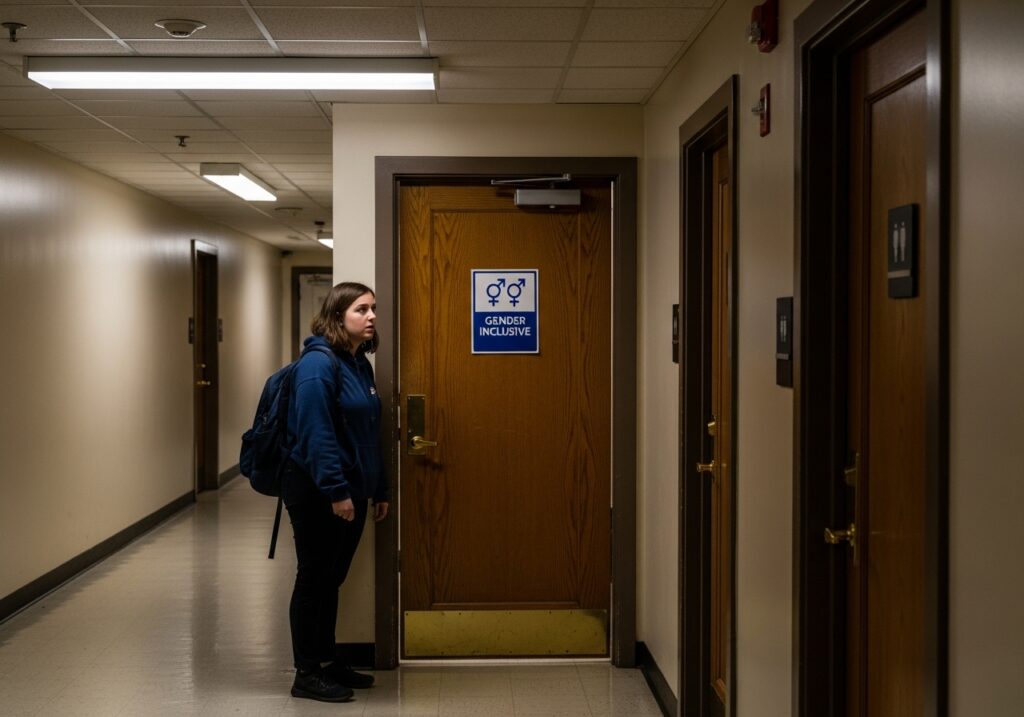
So why the complaint now? It all comes down to the school’s bathroom policy. UW-Madison has a rule that allows students, staff, and visitors to use whatever restroom or locker room they feel is “safest and most comfortable” for them—regardless of whether they are male or female. This includes people who identify as transgender, meaning they identify as a gender different from the one they were born as.
To be clear, the university’s policy says that no one is allowed to question or harass anyone over which bathroom they choose to use. That means a biological male who identifies as a woman can use the women’s restroom, and vice versa.
Defending Education argues that this policy puts women and girls in an unfair and uncomfortable position. They say it forces biological women to give up their right to private female-only spaces, which Title IX was meant to protect. According to the complaint, women who don’t feel safe or comfortable sharing a restroom with biological males are told to use the school’s limited number of single-use, all-gender restrooms instead.
“If women are uncomfortable sharing multi-stall restrooms with biological males, the University instructs them to use a limited number of gender inclusive, single-occupancy restrooms instead,” the group said. “That’s backwards,” they argue. “It’s the women who are being forced to change their behavior, not the men.”
The complaint also says that UW-Madison’s policies may be violating the Equal Protection Clause of the Constitution. That’s a part of the law that promises all people will be treated equally. Defending Education wants the Department of Education to investigate the school and force it to change its policy.
This isn’t the first time UW-Madison has been accused of going too far with its transgender policies. Sarah Parshall Perry, a legal expert with Defending Education, said this is the second civil rights complaint filed against the school in less than a year.
“The university’s policies leave biological females at the university without recourse,” Perry said. “That’s a clear violation of Title IX—a law passed to secure educational equality for women and for no other purpose.”
The Biden administration had previously pushed schools to adopt more transgender-inclusive policies, including changes to Title IX rules. But under President Trump, the focus has shifted back to protecting the original intent of Title IX—ensuring fairness and privacy for women and girls.
Secretary of Education Linda McMahon has made it clear that the Department is watching cases like this closely. If the Department finds that UW-Madison is violating Title IX, the school could face fines or even lose federal funding.
For now, the complaint is under review. But it’s part of a bigger national debate: Should schools prioritize gender identity or biological sex when it comes to private spaces like restrooms and locker rooms?
This case might help decide that question. And for the thousands of students at UW-Madison—and millions more across the country—the answer could change how schools handle these issues for years to come.