
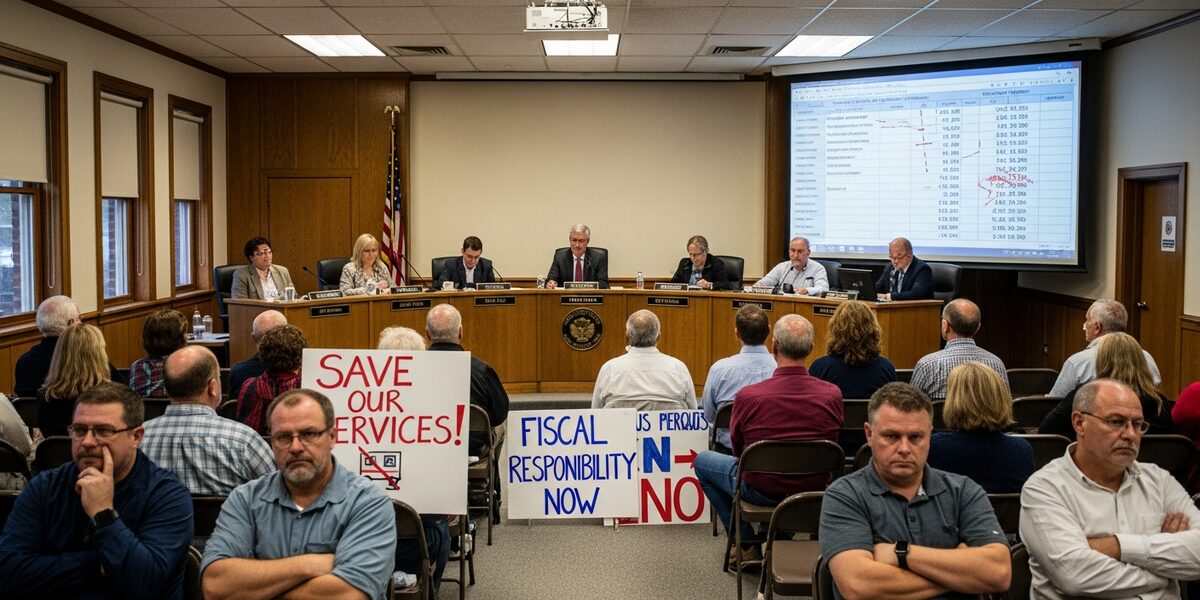
There’s a special kind of government insanity that only happens when politicians care more about moral posturing than basic arithmetic. It’s the kind where a city that can’t keep the streetlights on starts writing checks to fix injustices from 1850. And right now, it’s spreading through local governments like a virus that feeds on empty treasuries and full press releases.
The National Tour of Bad Ideas
The reparations movement is pushing forward in cities and counties across America — Cincinnati, Santa Clara, Asheville, Evanston, San Francisco — each one trying to figure out how to pay people money the government doesn’t have for crimes the government didn’t personally commit, while the actual services those cities are supposed to provide crumble in real time.
Let’s take the tour.
Asheville: Hurricane Damage Meets Social Justice
Asheville, North Carolina, might be the most absurd case study in the bunch. The city was devastated by Hurricane Helene — an estimated $1.1 billion in damage. The mayor has been flying to Washington begging for federal rebuilding money. The city announced $6.9 million in combined state and federal recovery funding, which against a billion dollars in damage is like putting a Band-Aid on a severed limb.
And their priority? Reparations.
Mayor Esther Manheimer testified before the House Select Committee on Government Efficiency about the city’s reparations initiative and its $30 million budget gap. In the same breath. A $30 million hole in the budget and an active reparations commission operating simultaneously, like a family maxing out credit cards while their basement floods.
The Department of Justice sent Asheville a letter threatening to investigate and take action if the reparations recommendations move forward. Manheimer’s response was essentially, “We’re committed to the community” — which is politician-speak for “we’re going to keep doing this until someone physically stops us.”
When asked what specific reparations proposal she’d support, the mayor said it’s “incredibly complicated.” Of course it is. Because the math doesn’t work, the legal ground is quicksand, and the only thing keeping the project alive is the political cost of admitting it was never viable.
Cincinnati: Rebranding the Word
In Cincinnati, NAACP President David Whitehead urged people not to get “confused and caught up with the word ‘reparation.'” He wants residents to think of it as “restoring people that have been unfairly treated.”
That’s not confusion about a word. That’s a marketing problem. When you have to tell people not to react to the name of your policy, the policy has a branding crisis that no amount of redefining will fix.
Cincinnati’s program would offer assistance to “low-to-moderate income residents” and people whose families were “prevented from buying a home due to discriminatory practices.” Which sounds reasonable until you realize that means creating a government program that pays people based on what might have happened to their ancestors in the housing market decades ago — a claim that’s virtually impossible to verify, means-test, or administer fairly.
Santa Clara: Waiting for the Agenda
In Santa Clara County, the reparations discussion was approved in January but hasn’t appeared on the agenda since. An advocate told local media she’d “be really concerned” if it didn’t surface by March.
It’s March. The city is dealing with budget cuts that threaten basic social services. And the reparations advocate’s pitch? “The goal right now isn’t to ask for, say, a $10 million package.”
Not yet, anyway. The vision includes “housing assistance, getting certain loans paid off or cash” as part of building “generational wealth.” Through government transfer payments. Funded by a city cutting social services. In a state where the governor already rejected multiple reparations bills to avoid legal catastrophe.
Evanston: The Lawsuit
Evanston, Illinois, gets credit for being first — the first city in America to pass a reparations plan back in 2019, pledging $10 million over a decade in $25,000 payments to Black residents for housing expenses.
The program just issued payments to 44 residents. And now Judicial Watch has filed a lawsuit to stop it, arguing the payments are racially discriminatory. San Francisco’s reparations fund faces a similar lawsuit.
This was always the legal iceberg waiting beneath the surface. Government programs that distribute public funds exclusively based on race face obvious equal protection challenges. The Fourteenth Amendment doesn’t have a footnote that says “except when the politics feel righteous.” And when these cases reach courts that take the Constitution seriously, the programs will likely collapse — leaving the cities with nothing to show for it but legal bills and broken promises.
California: No Champion, No Path
California’s reparations movement — once the most ambitious in the country — is effectively orphaned. Governor Newsom rejected multiple reparations bills. None of the gubernatorial candidates are championing direct cash payments. The state’s own former task force member admitted that advancing reparations will be “a long process” requiring changes to “practically every system.”
That’s an honest assessment, at least. But it’s also an admission that the reparations framework as currently proposed — government checks to individuals based on racial identity — was never the endgame. The real goal is systemic restructuring of finance, housing, hiring, and governance along racial lines. Reparations was just the door. The room behind it is something much larger.
The Math That Kills Every Proposal
Here’s the part none of these advocates want to confront. The cities pushing reparations are broke. Asheville has a $30 million budget gap. Santa Clara is cutting services. Evanston pledged $10 million over a decade for a city that struggles to maintain infrastructure. San Francisco can’t keep people from using the sidewalks as bathrooms.
These aren’t cities with surplus budgets looking for creative ways to invest. These are cities that can’t deliver basic services to current residents, proposing to create entirely new entitlement programs based on historical grievances that predate everyone involved.
And the federal government isn’t coming to help. The DOJ is actively threatening legal action against local reparations programs. The Trump administration has shown zero interest in funding racial preference initiatives. Any city that moves forward does so knowing the money has to come from local taxpayers — the same taxpayers already watching their services degrade and their property taxes climb.
The Question Nobody Answers
Every reparations proposal eventually hits the same wall: who pays, who receives, and where does it end?
Does a Black immigrant from Nigeria qualify? What about a biracial American? What about a white family that moved to the city in 2015 — are their tax dollars funding payments for injustices that happened before they arrived? What about a Black family that moved from Mississippi to Evanston last year — do they qualify for Evanston-specific reparations for redlining they didn’t experience in that city?
These aren’t gotcha questions. They’re the basic administrative realities that every program must answer, and none of them have. Because the moment you start drawing lines, the moral clarity of the movement dissolves into bureaucratic arbitrariness that looks less like justice and more like a government lottery based on skin color.
The Bottom Line
Reparations as a concept will continue to generate press conferences, commission reports, and passionate advocacy. But as an actual government program, it’s dying on contact with reality — budget deficits, legal challenges, administrative impossibility, and a federal administration that has made clear it won’t tolerate racially exclusive spending of public funds.
The cities pushing this forward aren’t solving historical injustice. They’re creating new injustice — robbing current taxpayers to fund programs that can’t survive legal scrutiny, in cities that can’t afford the services they already owe.
Asheville can’t rebuild from a hurricane and fund reparations. Cincinnati can’t rebrand its way past constitutional law. Evanston can’t write $25,000 checks without getting sued.
The math doesn’t work. The law doesn’t work. And the politics only work until someone asks where the money comes from.
That question just got a lot louder. And nobody pushing reparations has an answer.