
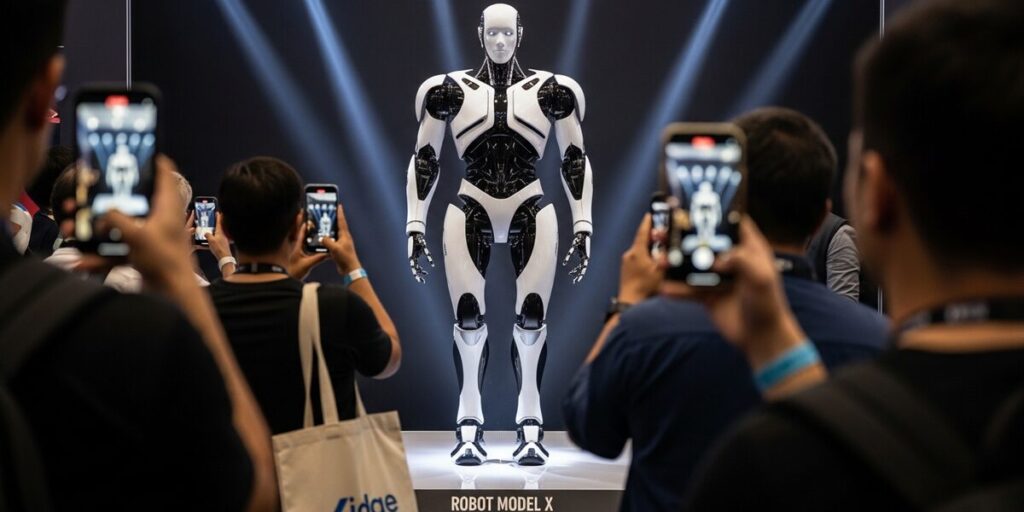
There are two kinds of reactions to China’s latest robot showcase, and both of them should concern you.
The first: “That’s terrifying.” The second: “That’s fake.” And the uncomfortable truth is that either answer leads to the same place — a country that is either building humanoid combat robots at a pace that defies physics, or running the most sophisticated propaganda operation in tech history. Neither option is great for the rest of us.
At China’s annual CCTV Spring Festival gala — a broadcast that reportedly pulled 677 million live viewers and 13.5 billion clip views — Unitree Robotics put on a show that looked like it was ripped from a science fiction movie. Humanoid robots performing drunken boxing. Sword work. Staff combat. Breakdancing. Backflips. Choreographed gymnastics alongside acrobatic children.
The robots moved with fluidity that, one year ago, didn’t exist. At last year’s gala, robots were stumbling around waving handkerchiefs like your uncle after too much eggnog. This year they’re doing martial arts routines that would impress a Shaolin monk.
“In just one year, they have evolved from robots to ‘humans,'” AI entrepreneur Tansu Yegen wrote. That’s either the most impressive engineering leap in modern history or the most impressive editing job.
Real or Memorex?
The skeptics aren’t fringe. One X user claimed to have seen the same Unitree robots at a live demo in Shenzhen a month before the gala. His assessment was blunt: “They’re slow, shaky, and can barely shuffle let alone do any of this. This isn’t the first time Unitree has used CGI to fake capability.”
That’s a serious accusation. And it hasn’t been debunked. But it also hasn’t been proven. No concrete evidence has emerged that the gala footage was doctored. The performance aired on state television in front of an audience of hundreds of millions. Faking it at that scale would be a gamble — not because China’s government is above deception, but because getting caught would humiliate the tech companies and the state media apparatus in front of the entire country.
So we’re left in the worst possible position: uncertain. We don’t know if China’s robots can actually do what they showed. And that uncertainty itself is a weapon.
Why It Matters Either Way
If the robots are real, the implications are staggering. Humanoid robots capable of coordinated martial arts, weapons handling, and acrobatic recovery after falls aren’t entertainment novelties. They’re prototypes. Strip away the kung fu choreography and what you’re looking at is a machine that can move through complex environments, handle objects with precision, recover from disruption, and coordinate with other machines in real time.
That’s not a dance partner. That’s a soldier. Or a surveillance unit. Or a manufacturing line that never sleeps, never strikes, and never asks for a raise.
China isn’t building robots to win talent shows. They’re building the labor force and military assets of the next century. The gala is the showroom. The factory is somewhere else.
If the robots are fake — if this is CGI and state propaganda — then China is running an information warfare campaign designed to make the West believe it’s further ahead than it actually is. That’s a different kind of threat but still a real one. Perception shapes investment, policy, and military planning. If American defense strategists believe China has combat-capable humanoid robots, it changes procurement priorities, research funding, and strategic posture — even if the robots can barely walk.
China wins either way. Real capability or perceived capability — both shift the balance.
The Arms Race Nobody’s Talking About
While Washington argues about tariffs and TikTok, China is pouring resources into robotics, AI, and autonomous systems at a scale that makes Silicon Valley’s efforts look like a science fair. Unitree is one of at least four robotics companies that performed at the gala. Another company, EngineAI, is launching a robot combat tournament with a $1.4 million solid gold belt as the prize.
A gold belt. For robots fighting each other. China is gamifying military robotics development and turning it into a spectator sport. That’s not a research program. That’s a cultural movement designed to attract talent, investment, and public enthusiasm for autonomous warfare technology.
Meanwhile, in America, our robotics conversation is mostly about whether Boston Dynamics’ dog robot is creepy. We’re not in the same league. We’re not even playing the same sport.
The One-Year Problem
The gap between last year’s gala and this year’s is the detail that should keep defense planners awake. In 2025, China’s showcase robots were clumsy, slow, and barely functional. In 2026 — real or enhanced — they presented machines doing backflips with swords.
Even if you discount the footage by 50%, the trajectory is alarming. Robotics capability doesn’t need to be perfect to be dangerous. It needs to be good enough. Good enough to patrol a border. Good enough to clear a building. Good enough to operate in environments too dangerous for human soldiers. And “good enough” arrives a lot sooner than “perfect.”
China is sprinting. America is debating. And somewhere in Shenzhen, a robot is either doing a backflip or someone is very good at making it look like it is.
Either way, we’d better start paying attention.