
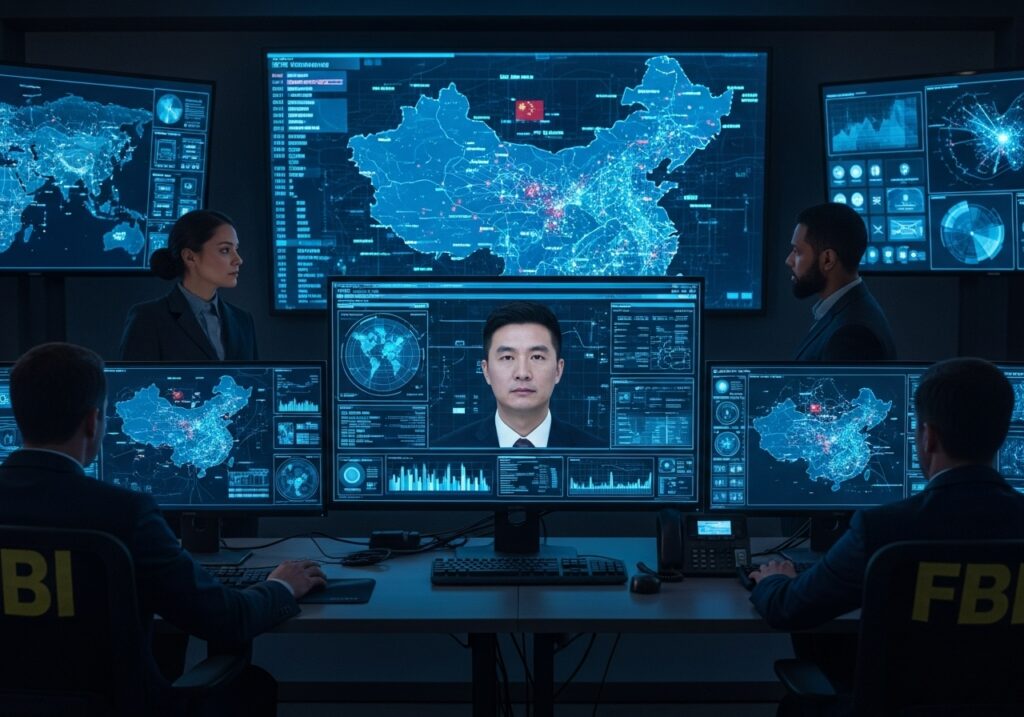
America is under siege—not by tanks or soldiers, but by covert cyber warriors working tirelessly from behind computer screens, serving the interests of an adversary that sees our innovation as nothing more than a treasure trove to plunder. The recent indictment and arrest of Chinese national Xu Zewei offers a chilling reminder of the dangers we face from state-sponsored espionage, as our COVID-19 research, crucial to national health and security, has become the latest target of Beijing’s cyber mercenaries.
Xu Zewei, apprehended as he stepped off a flight from China into Milan, Italy, now awaits extradition to the United States. He stands accused of hacking into multiple American universities and stealing sensitive COVID-19 research at the direct instruction of China’s Ministry of State Security (MSS). This isn’t some rogue individual with a laptop and a grudge—this is espionage coordinated by the Chinese Communist Party (CCP) itself. As Nicholas Ganjei, U.S. attorney for the Southern District of Texas, bluntly put it, Xu was “hacking and stealing crucial COVID-19 research at the behest of the Chinese government while that same government was simultaneously withholding information about the virus and its origins.”
The indictment reveals the depth and breadth of this operation. Xu was not just an isolated actor; he was a general manager at Shanghai Powerock Network—a company explicitly tasked by China’s intelligence services to infiltrate American institutions. This disturbing arrangement is hardly unique. The Chinese regime consistently leverages private companies to conduct espionage, creating plausible deniability for Beijing while relentlessly stealing from America. Brett Leatherman, assistant director of the FBI’s cyber division, underscored the gravity of this threat, noting that through hacking group Hafnium, the CCP targeted over 60,000 U.S. entities, successfully victimizing more than 12,700 to steal sensitive information.
The universities targeted by Xu remain unnamed in public documents, known only as “UNIVERSITY 1,” “UNIVERSITY 2,” and “UNIVERSITY 3.” Two are located in Texas and one in North Carolina. Xu and his co-conspirators specifically targeted email accounts belonging to prominent immunologists and virologists, gaining access to their research on vaccines, treatments, and testing methods. The implications are clear: China isn’t merely spying for economic gain; they’re weaponizing our own scientific achievement against us, attempting to leapfrog America by stealing the fruits of our national investment and ingenuity.
This operation is not isolated; it’s a symptom of a broader strategy. China’s cyber aggression is a persistent threat to our economy and national security, targeting intellectual property across sectors from manufacturing to military technology. Our universities, often seen as open institutions fostering global collaboration, have become soft targets exploited by hostile nations. It’s past time for academia and industry alike to wake up to the reality that openness, without vigilance, leaves America vulnerable.
President Trump has long warned of the CCP’s aggressive espionage tactics, championing hardline measures to protect American innovation. His administration has consistently advocated an America First approach, prioritizing border security, manufacturing revival, trade reform, and education reform alongside ending foreign entanglements. Securing our cyber borders must now become an equally critical pillar of this agenda. America cannot afford complacency in the digital age; the cost is simply too high.
The FBI’s success in capturing Xu, described as “one of the first hackers linked to Chinese intelligence services to be captured,” is a crucial victory, but it cannot be an isolated event. We must strengthen our cyber defenses, increase transparency around foreign funding and influence in our universities, and hold hostile nations accountable for their actions.
Xu’s lawyer claims mistaken identity—an excuse that strains credulity when confronted by the mountain of evidence gathered by diligent FBI agents. America must stand firm, unyielding in our resolve to protect our nation’s most critical assets. The Trump administration’s aggressive stance against Chinese espionage must continue unabated. We have witnessed the lengths to which China will go to sabotage and infiltrate our institutions; now we must respond with strength, vigilance, and an unwavering commitment to America’s security and sovereignty.